A home-repair assistance data API teams can test before a license decision
Home-repair assistance is fragmented across federal, state, county, city, utility, tribal, and nonprofit sources. A product team that wants to help a homeowner find possible repair funding can either assemble those sources itself or integrate a maintained discovery layer. The Grant Map API is our attempt to make the second path practical and testable.
Start with evidence, not a sales call: open the no-key sample explorer, inspect the record schema and OpenAPI 3.1 contract, and read the current data-health result. The commercial-readiness result is the fail-closed decision for commercial annual self-service checkout. The result is not an accuracy warranty, availability promise, source-rights opinion, or approval of a buyer's use case. Paid file, snapshot, and bulk-export delivery remain unavailable because there is no approved storage or buyer delivery channel and every included source domain still requires a reviewed rights decision. Nonprofit or academic access and assisted pilots require manual review instead of self-service checkout.
What the API is designed to do
The API organizes published records for grants, rebates, forgivable loans, repayable financing, accessibility work, weatherization, healthy-home repairs, disaster mitigation, and related assistance by city. The record contract supports separate English and Spanish description, amount-label, and deadline fields, cited URLs, structured project and audience fields, and a freshness object with scoped evidence. Program names remain English in the current schema, and the presence of a localized field can vary. An integrator needs an explicit field-level fallback.
It is designed for discovery, product routing, research, and counselor workflows. It is not an eligibility engine, grant application, underwriting input, or promise that funding is open. The administering organization still controls current eligibility, funding, benefit terms, deadlines, and the application route.
One city row is not one distinct program
A city-program row is one record associated with one city. Statewide, regional, and selected national records can appear in several city collections by design. The health endpoint's distinctPrograms measure groups unique stored names, while locallyUniquePrograms counts names that appear in one city. Those are catalog measures, not verified legal identities, administrators, awards, or current openings.
Keep the city and record ID together because the schema defines the ID as stable within its city. Do not consolidate rows on name alone, and do not describe a row count as a count of separate programs. The data-model guide explains the distinction.
Four evaluation surfaces are public
- Sample data:
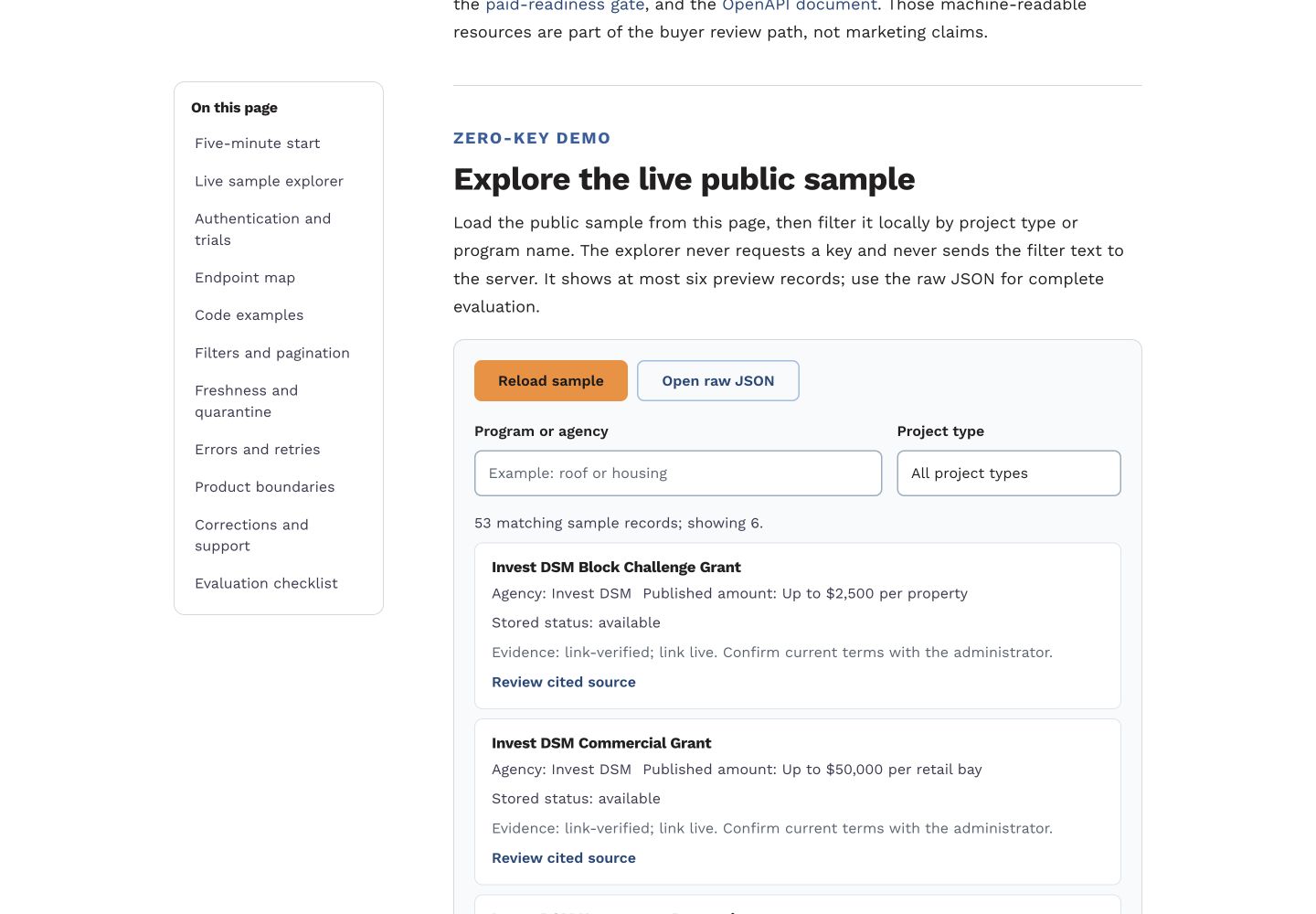
GET /api/samplereturns the non-quarantined, in-scope collection for one evaluation city without a key. - Developer contract: the developer guide, OpenAPI document, and JSON Schema show the supported shape and errors.
- Data-health evidence:
GET /api/dataset/healthreports current coverage, link-health categories, exclusions, audit status, and last-run dates. - Commercial gate:
GET /api/data/readinesssays whether the exact corpus, audit, rights, recurring-operation, and delivery requirements allow commercial annual self-service checkout. It does not make paid files, snapshots, or bulk exports available.
What the live evaluation looks like
What an integration can look like
Renovation and home-finance products
After a homeowner chooses a city and project type, show possible assistance records beside financing options. Keep the cited source and verification warning visible; do not reduce a loan amount or make a credit decision based on an unconfirmed benefit.
Housing counselors and community organizations
Use audience, income-requirement, project, and geography fields to build a research list before a counseling session. The result can reduce repeated searching without replacing the counselor's source review or the administrator's decision.
Home-service and contractor platforms
Give a homeowner a possible-funding research path before or alongside an estimate. The licensed program API does not include homeowner leads or contractor-account data, and a possible match should never be described as awarded money.
Why the freshness object matters
A single “verified” badge would hide too much. A URL can resolve while the stored amount is stale; a source review can establish program identity without proving the amount; a page can block automated checking while remaining useful to a human. The contract separates link status, last-check date, confidence scope, and source-review age so an integrator can choose conservative behavior.
For a consumer-facing workflow, reject known dead links, surface an available citation, mark unknown funding as unknown, and tell users to confirm decision-driving facts. For analytics, keep link status and review dates in the downstream table so age and uncertainty remain queryable.
Keep the exact response identity you evaluated
Successful contract responses include an X-Request-ID and X-API-Version. Successful dataset responses also include X-Dataset-Revision, which identifies the effective served generation; it does not certify that the records are complete, accurate, or suitable for a decision. Store these values with evaluation notes and correction reports, never a raw API key.
The public sample, API-record schema, export-row schema, and OpenAPI document support ETag and If-None-Match. Licensed responses are private, no-store, vary on X-Api-Key, and omit ETags. The developer contract defines the current version, revision inputs, request-ID rules, conditional requests, and deprecation policy.
What a serious 30-day evaluation should answer
- How long does the first successful request and basic integration take?
- Does the proposed city, category, or audience slice contain useful records?
- Which fields does the product actually use, and which are missing?
- How many inspected records need correction, and how consequential are the defects?
- Can the product present citations and uncertainty without confusing the user?
- Do change events alter a real downstream workflow?
- What annual volume and support model would production require?
Free evaluation keys are deliberately scoped: they expire within 30 days and allow one to five approved live cities. That is enough to test product fit without pretending that an unbounded trial is a production license.
The offer after an evaluation
The assisted-pilot offer hypothesis is $1,500 for 90 days, but it is not available through self-service checkout. Pilot availability is held pending reviewed scope and retention terms; an inquiry is not approval or a promise that the pilot will be offered. The nonprofit or academic offer hypothesis is $2,000 per year, with eligibility, permitted users, and access scope reviewed manually rather than defined by this article. The commercial annual offer hypothesis is $9,000 per year and may use self-service checkout only while the published commercial-release gate is green. These prices are offers to validate, not proof of market fit.
No price on this page buys a downloadable file, snapshot, or bulk export today. A local versioned file candidate is an internal release artifact, not a delivery channel or buyer entitlement.
Evaluate the product, contract, and evidence
Use the live sample explorer and copyable quickstarts first. Then request a bounded trial for a named use case and one to five cities.
Open the sample explorer Request an evaluationCommon questions
What does The Grant Map API provide?
It provides structured, city-organized home-repair assistance records with published program fields, cited URLs, scoped freshness and confidence signals, and a licensed change feed. The schema supports separate English and Spanish description, amount-label, and deadline fields, but program names remain English and field presence can vary.
Does it decide whether a homeowner qualifies?
No. It is a discovery and routing layer. The administering organization decides current eligibility, funding, benefit terms, timing, and the application route.
Can a buyer test it without a key?
Yes. The public sample returns the non-quarantined, in-scope collection for one evaluation city. The developer guide, schema, OpenAPI contract, data-health result, and commercial-readiness result are also public.
Is every record verified and current?
No. Coverage and confidence vary, and stored fields can be stale or incomplete. A live URL does not prove every stored fact. The product exposes evidence and known exclusions so a buyer can measure and handle uncertainty rather than inherit a hidden claim.